Thursday, September 17, 2015

An Appalling Lack of Imagination And What it May Lead To


I think the quote illustrated above represents quite perfectly the issue I hope to address in this article. The prevalence of this problem was made startlingly evident to me just a little while back, when an old and very dear friend stated emphatically and honestly that she did not like fantasy books, in any way, shape, or form. As a lover of all things imaginative, I was cut to the heart, and could barely form words to reply (in a polite manner) to this unequivocal and, to me, most unfamiliar philosophy.


   My younger days centred quite wholly around books (as they still do and will always), and I literally cannot remember a time when I wasn’t devouring some exciting new classic, such as Peter Pan. I recall leaving my bedroom window open for quite some time after reading it, in fervent and vague hopes that Tink and Peter would fly in and escort me to a land of pirates and redskins. That glad day never arrived, sadly, and so I contented myself with imagining what it would have been like for Wendy and her two brothers to enjoy that great adventure, so dear to the thoughts of many children still.


   See, imagination is a very strong and important influence in the world of a child. It leads the young on so many new and marvelous paths, while strengthening that ineffable, inimitable sense of wonder and joy at the glory of God’s creation. That sense of wonder does sometimes remain, if carefully preserved and nurtured, into the teenage years and even occasionally into adulthood. But with the accelerated maturity of today’s youth, there is usually no attempt made at retaining the youthful sentiments mentioned above. Instead, kids these days are encouraged--no, I should rather say pushed--to believe in only real things. No Santa Claus. No fairies. No anything of that stupid and made-up ilk.

 I myself can think of many long-past examples of being made fun of for my fantastical beliefs in the world of the fantastical; such things as fairies were just not cool. They were labelled as babyish and foolish, but I couldn’t--and still don’t--understand this strange, realist mentality. Whatever happened to being a child for a bit? To dreaming blissfully of inhabiting the rosy worlds of Narnia, and Middle Earth? Imagination is fast being eradicated, and there is really not so much we can do it except to keep it alive within ourselves--and remember to hold fast to the joy and wonder that is all too easily lost and crushed with the passing of the years. Keep in mind the words of the Gospel of Matthew, “Unless you become again as little children, you shall not enter the kingdom of Heaven.” Do not lose the amazement at the grandeur of God, for it is all too possible that with losing that, you will lose the way to heaven.

Maura Tuffy

Saturday, August 22, 2015

At Sea

Far distant was the shore; no seagulls cried,  
       No loud, approaching voices on the wing.
    No other noise was there, save water’s lap,
    Out on the salty ocean, far from shore.


   The crewmen, silent all, were still and cold,
   Not one stepped forth to look with steadfast eye;
   Movement on this vessel long had ceased,
   Out on the salty ocean, far from shore.


    The captain in his swinging hammock lay,
   Dead fingers round a telescope tight curled;
  He’d still not sighted land when last he fell
  Out on the salty ocean, far from shore.


    A ship’s boy, by the mast lay slumped asleep,
   Upon this first voyage he’d longed to go;
  He never knew that he’d  float there forever,
    Out on the salty ocean, far from shore.  
   The first-mate, and the second, lay nearby,
   O’er cards, the game turned now eternal;  
What coins had each ship's hand there lost and won?
  Out on the salty ocean, far from shore.


   Lonely now are all of these poor sailors,
   No friends now, drifting on forever.  
  To souls’ Judgement now is thought their only course,
     Out on the salty ocean, far from shore.

Tuesday, July 7, 2015

Beauty and the Beast


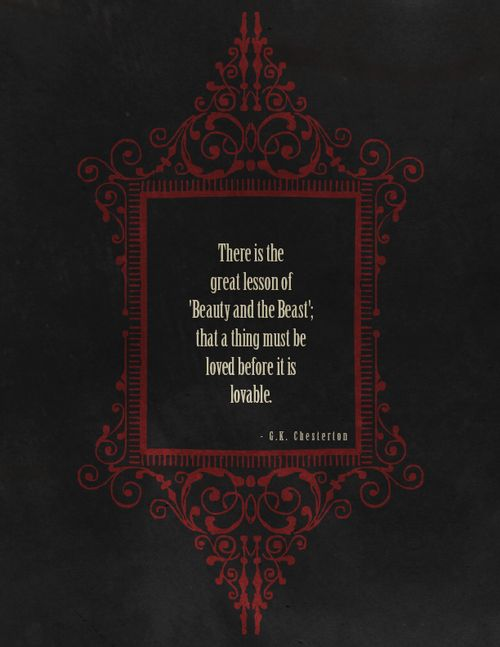
“There is the great lesson of Beauty and the Beast; that a thing must be loved before it is loveable.”  
                                                                                           Gilbert Keith Chesterton


    I have never attempted to write anything about anything of Chesterton’s before; it is a daunting task. But I hope, in a few paragraphs, to convey the meaning of this opening quote about Beauty and the Beast.


  We generally feel an affection for what is beautiful. It is only to be expected that we are drawn to all the agreeable things we see. But in the case of Beauty and the Beast, the poor Beast was quite the opposite of agreeable. He was, by all accounts, hideous. When Beauty came to live at his castle, she was repulsed by him. The thought of sitting to dine with him made her quite ill. But, being unwilling to offend, she stuck it out, and discovered that the Beast was actually not so bad. He could converse wittily, was well read; in fact, the only thing he was deficient in was good looks. But when he asked Beauty to marry him, she was appalled, and so turned him down. She could not bear to have an unbeautiful husband.


  Later in the story, however, when Beauty rushes back from her holiday with her sisters and finds the Beast dying, she suddenly realises something--she loves Beast. She cannot bear to think of losing him, and, in a flood of tears, and holding the Beast close, she tells him so. In that instant, as she tells him how much she loves him, the Beast changes into a wonderfully handsome prince. He is now quite obviously loveable, and of course the two get married, live happily ever after, et cetera, et cetera, et cetera. How wonderfully simple it all is in fairy tales!


    We see that Beauty had to love the Beast before he appeared as loveable. This explains the Chesterton quote in the opening of this essay, that something must be loved before it is loveable. When one meets somebody new, they are not perfect by any means. But with closer and deeper knowledge and acquaintance with the person, we gradually see that these minor faults do, in fact, make up a beautiful kind of perfection in and of themselves, in much the same way that the peaceful silence of the meadows is full of small noises which make up one great and all-encompassing quietness.


    Hopefully this has helped some of you to understand this quote of one of the greatest writers of our age, without beating about the bush too much. The excerpt was taken from Ethics of Elfland, a chapter in Chesterton’s famous work Orthodoxy. I have only read the one chapter, but finding it to be all about fairy tales and such, I found it most engaging, and look forward to reading some more of the whole book in the near future.
Maura Tuffy

Rainbows Everywhere


“He never chooses an opinion, he just hears whatever happens to be in style.”
                                                                                                         ---Leo Tolstoy

     It seems that rainbows and pride quotes are in style after the recent Supreme Court decision on same-sex “marriage”. I've seen much rejoicing on many different social media pages such as Instagram, Facebook, and such. Everyone has been changing their profile picture to a rainbow theme, and posting quotes like “Love is love no matter who you love” and “#pride” and all that.


  Well, as a traditional Catholic and a supporter of real marriage, I am absolutely sick of having rainbow flags and pride slogans shoved down my throat every day. I went into the city last Thursday with some friends, and a certain bank (I forget which, but it wasn't Chase, although Chase Bank is a big advocate also) had rainbow flags filling the windows. I wonder how many sponsors that bank gained as a result. It makes no sense that so-called diversity is not diverse in its choices of what to be diverse about. It’s okay to believe in gay marriage, to stand up for your “rights” on that matter, but if you make any kind of public protest about traditional marriage, you will literally be shot down where you stand. What’s “diverse” about that? There is no diversity, only a sick kind of worldly liberalism which opens its grasping arms to nothing that is right and to everything that is perverted.


  It's not that the Church hates anybody and everybody who is homosexual; we've all heard the old saying, love the sinner and hate the sin. But oftentimes the sin is such a part of the sinner that it's difficult to separate the two and that's where things get a bit tricky. Sometimes, Catholics are misrepresented as bigoted, narrow-minded despisers of everybody who does not conform to their old-fashioned sense of morality. And then there is the other extreme, which is being propagated by today's charismatic Masses, unhabited nuns, lax morality, and, I am sad to say, even some of our priests; that Catholics are liberal, and all-welcoming, opening our church doors wide to envelope all kinds, divorced and remarried, active gays, unshriven and unrepentant, etc. It can be hard to know what to believe in any more these days.


  Real marriage is between a man and a woman, not a man and a man or woman and a woman. I think that soon there will be more gay married couples than married straight ones. Why do homosexuals seem to be bigger advocates of marriage than normal couples? Same-sex marriage is unnatural and wrong. It’s such a shame that marriage is being attacked in this fashion.

   The abomination of gay marriage is ruining the United States. All we can do is pray and hope that this situation will not take over everything.

Maura Tuffy

Tuesday, June 30, 2015

Society: A Conundrum


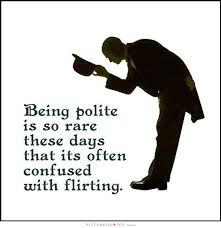
Aside from the glaring typo in this quote of unknown origin, I would wholeheartedly agree with this statement. Politeness is increasingly rare; for the most part it is quite frowned upon. Men on the train or any other form of public transportation don’t rise to let a lady sit. Why?

  The answer is, in part, feminism. Feminists want to be absolutely equal to men. What, a man offering me a seat? He must think me weak and inferior to him! This cannot be allowed! We women must strive for masculine strength in order to appear equal in both mind and body to men.
   This is not actually my view, but my view is not quite the opposite of the above one. Women and men should be complements to one another; the strength of men to the gentleness of women, a man’s height to a woman’s smaller stature, et cetera. After all, if we look back all the way to Genesis, we will see that man and woman were literally made for each other. Adam could not survive without Eve so God saw it fit to make her.

   Unfortunately, people today have really forgotten almost everything represented in Genesis. All they seem to see is some sort of vague, indefinable inequality between the sexes when really no such inequality is, in fact, present. The main notion of most people today is that men are generally perceived as better leaders, fighters, doers, and such things. Well? What is so bad about that? Is there anything bad about it? Women can do an awful lot of things men can’t do. Women are better home-makers. They also feel more, perhaps, than men do. Men act directly on impulse whereas women wait, and think it out first.

  This, of course, happens to be yet another good reason for the cause of traditional marriage, e.g., one man and one woman. The two will balance each other out, helping one another to act to the best of their abilities and create a good home for their potential children. Same sex marriage will not accomplish this in any way whatsoever. Besides being absolutely unnatural and totally wrong, it is not real in the eyes of the Church and has been condemned by God. But it has been accepted and lauded from the rooftops by the government as a very good and even honourable way to live. After all, it doesn’t matter what the Church thinks so long as we all can be with whoever we please, right?

  Wrong. We should certainly not have to cave to what society would have us do and believe about everything. That is how we became the way we are today; diversity is actually nonexistent, rather than abounding as people think it to be. But I will write about the diversity issue later; back to the role of the Church in society.

  Holy Mother Church recognises the respective abilities of man and woman, which is why she has given us such good examples of holy men and women, living lives that reflect the virtues of Catholicism. Take St. Agnes, for example. She was martyred for her wish to stay pure, a wish which God, by His grace, granted to her. Hardly any young woman in today’s culture would safeguard herself unto death. If she did so, society would frown upon her as odd and old-fashioned. Why, when someone behaves wantonly, are they applauded, and when someone upholds virtue they are sneered at?

  It’s because of the radical idea of freedom. Well--perhaps not exactly freedom, for we all have our own free will, but more what one uses one’s free will for. One is expected, and all but required to use one’s will loosely, to just go about and satisfy worldly desires instead of tempering one’s feelings to suit not oneself, but the wishes of God.  

   Anyway, the lack of the understanding of men and women in society has brought low traditional marriage, and perhaps has even sped on the Supreme Court to its fatal decision of last week. Thankfully, there are still quite a few of us so-called “Traditionalists” who are still following the Church, even though that is of course a very archaic, (one might even say a medieval) thing to be doing. But it is a very good thing to be doing, because gradually there appear to be fewer and fewer people doing it, and this is exactly why it is unfashionable. A thing has to be fashionable to be in any way emulated by popular society, and hardly anything old-fashioned is popular.

  So, to revisit the intended topic of this bit of writing; men, be strong and polite. Women, be virtuous and kind. And, everybody, support the Church as an example of virtue in an age where virtue is falling into the gutter.

Maura Tuffy

Sunday, June 28, 2015

The Importance of Chivalry


“The motto of chivalry is also the motto of wisdom; to serve all, but love only one.”
----Honore de Balzac

   Really? Wow! I wish I lived in a time where this chivalry thing existed more widely! Today’s motto of wisdom might be rewritten as, “to serve oneself, and love only oneself.”
   You see, most people who really ought to be practising chivalry are instead being very selfish. They have little to no respect for what is left of the good, the true, and the beautiful. They are drawn irresistibly to the perverted and wrong. They seek it out and (incredible to comprehend) seem to thrive on it. All they have at heart is their own self-interest. Why? When did we change from noble knights and gracious ladies into selfish pigs without so much as a thought for others?  


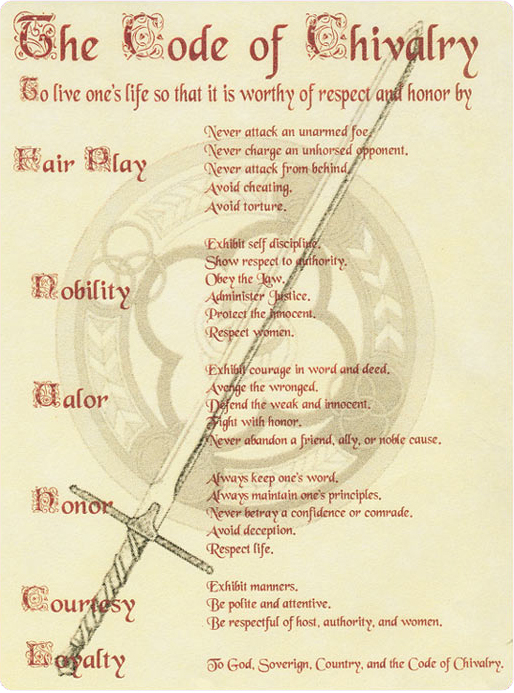
  Under ‘Nobility’ on the Code of Chivalry, we see ‘Respect Women.’ What? Respect? How old fashioned! Today’s young men would not be caught dead respecting their female friends, if they are even lucky enough to have any real ones. You will never hear a boy telling a girl she looks pretty. Oh no. Instead will be heard all manner of other words, (e.g., the infamous “hot”) which, though are meant to be flattering in today’s society, are actually very disrespectful. There is no idolisation of virtue. There is no talk of beauty, of purity. There is no decency.


   But, nevertheless, there should be. Chivalric virtues are important for men, and to women. Respect is, in a way, a kind of attention. To be respectful to anybody, you must acknowledge them and speak to them. This is paying them something we all seek, in one form or another, and it is attention. Attention is sought after instead of respect. Respect has evolved into attention, sadly, and oftentimes the methods employed to gain attention are downright sad. For example, having a lewd mouth, a lot of touching, immodest dress--it would be ridiculous, if it weren’t pathetically sad.


  What’s even more ridiculous, though, is that this kind of behaviour has become the norm for so many. Girls today think attention is absolutely the thing to be getting from a guy, no matter what the attentions may be, or how those attentions are attained. And those guys know that girls are just hanging on their every action, waiting for a word or look.


   When did all this happen, and why? I do not know. But one thing I am sure of; real friendship between boys and girls is very important. Many friendships are tainted, but if one strives for the good, the true, and the beautiful, you will be someone who anybody with sense would be proud to call a friend.


  So, what to do? There seems nothing is to be done. Nothing can change all the boys and all the girls in the world. But we can change ourselves. We can be kind to one another. We can help people in difficulty. This is a good thing to do, and goodness is key in a world gone bad. And if people see us changing, maybe they will want to emulate us. Inside every person is a wish for good. And the best way to propagate that good is by showing examples of kindness to our friends and family.  

Maura Tuffy

Tuesday, June 2, 2015

The Three Theological Virtues; Faith, Hope, and...


“Three Hail Marys for the three Theological Virtues of Faith, Hope, and Love--”
“It’s actually Charity, pet.”
“I thought it was Love...we used to say Love...”
“But Charity means so much more than Love. Don’t you think so?”


I am not one to kick up a fuss simply over one, small, simple word in a great Rosary, which gives glory to the Blessed Mother no matter if one says Charity or Love, but this particular word I happen to have quite set ideas about, so I do not think that Charity should be used instead of Love. Despite charity being a rather archaic word (and I do love archaic words and use them often) I believe Love to better fit as the third and last Theological Virtue.  


  This point may be argued. The Greek word agape translates to mean both charity and love, but those two words are very, very, different. Here is my opinion on the matter.


  You see, charity is defined, typically, as ‘the voluntary giving of help, typically in the form of money, to those in need.’ While this is undoubtedly a very laudable and Catholic practice--why else, after all, are there charity boxes in our churches--love in fact does have a much deeper meaning.


  Charity is being kind. It is being nice to people, whether you like it or not. It is patience. It is also respect. It is putting up, perhaps, with an annoying sibling. It is saying sorry first. You can put money in the poor box just because your conscience tells you you should, but there will be not a spark of love when that kind of charity is the reason. There are many more things that charity is, also, but there is one thing that it is most definitely not; charity is not love, hence the two words cannot be interchanged.


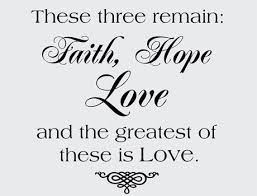
  Love is all that charity is and more. Charity is being nice to people whether you like it or not, but love is being nice to them anyway, without even thinking of yourself. Love is in and of itself a kind of charity. To quote St. Paul, 1 Corinthians 13.13, “And now these three remain: faith, hope and love. But the greatest of these is love.”

The greatest indeed of these is love. Love is giving yourself selflessly. It is the ultimate form of charity. God gave us Jesus, who was Himself God. Can there be anything more loving than giving yourself to save mankind? Love is so much more than charity. We should pray to love our friends and families as much as God loves us. When we attain that love, then we can hope to have gained true charity also. And what better way than to pray for Faith, Hope, and Love? For there can be charity without love, but never can there be love without charity.

Maura Tuffy